
The timing belt is one of the most important components in your engine and one of the most anxiety-inducing service items for Malaysian car owners. The cost varies significantly between workshops. The consequences of ignoring it are severe. And the information available online is often either too vague to be useful or too specific to be trusted.
This article gives you the honest numbers, explains what drives the variance, and tells you what a quote outside the expected range should prompt you to ask.
What the timing belt does and why it matters
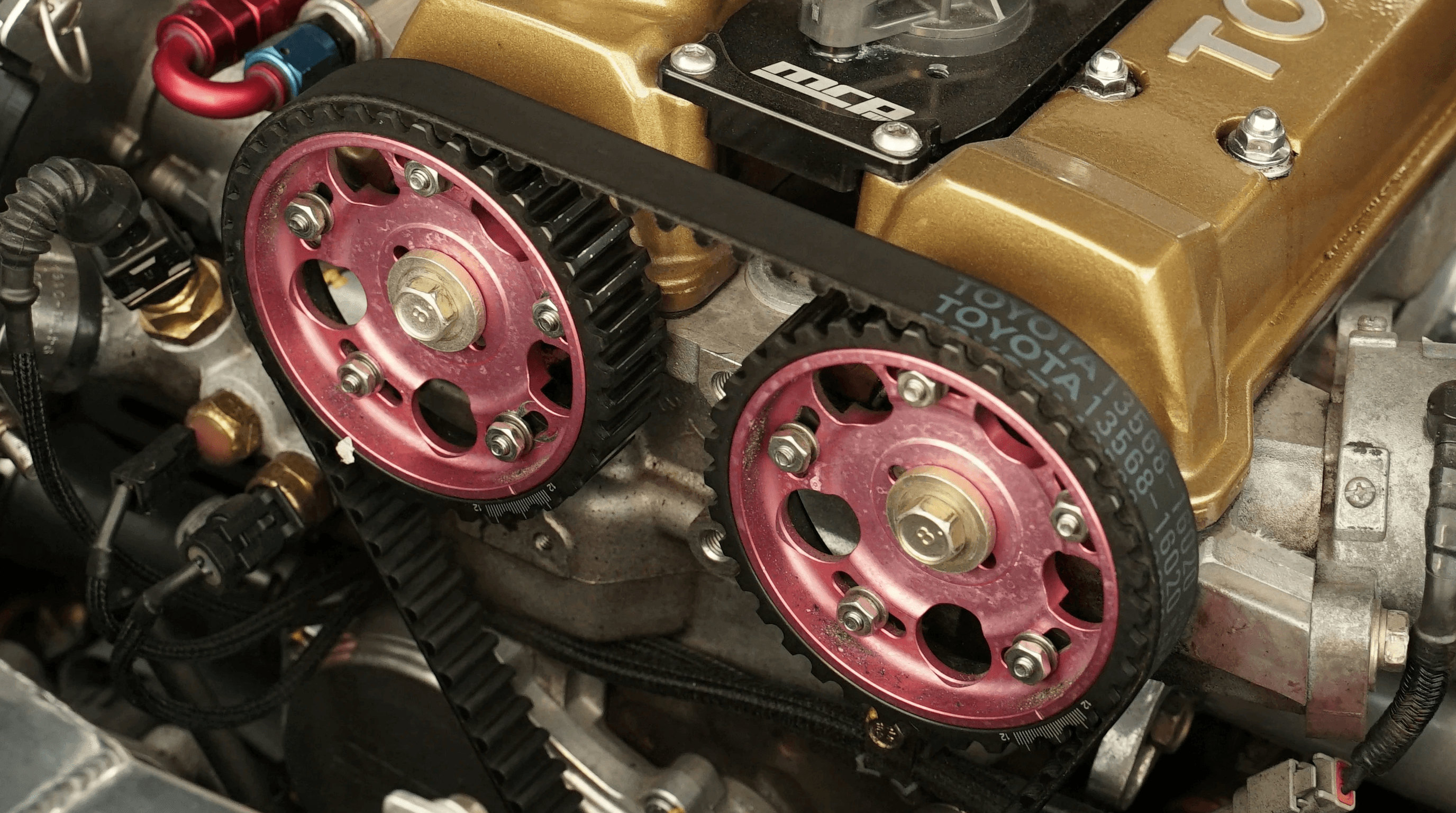
The timing belt synchronises the rotation of the crankshaft and camshaft — in plain terms, it keeps the top and bottom of your engine working in the correct sequence. If it fails, the engine's components can collide. On most Malaysian cars, this means bent valves, damaged pistons, and an engine repair bill that makes the timing belt replacement cost look trivial by comparison.
The timing belt does not show obvious signs of wear before it fails. It does not make a noise. The car does not handle differently. It simply snaps, and then the engine stops, often in traffic.
This is why the service interval is not optional. Replace it at the mileage or time threshold your manufacturer specifies — whichever comes first.
Replacement intervals for common Malaysian cars
Car Model | Interval (km) | Interval (years) |
|---|---|---|
Perodua Myvi (2005–2011) | 100,000 | 5 |
Perodua Myvi (2012–present) | Timing chain — no belt | - |
Perodua Alza | Timing chain — no belt | - |
Proton Saga / Iriz (1.3 VVT) | 60,000 | 4 |
Honda City / Jazz (L15) | 100,000 | 5 |
Toyota Vios (1NZ) | 100,000 | 5 |
Mazda 2 / 3 (Skyactiv) | Timing chain — no belt | - |
Note: Many modern cars have switched from timing belts to timing chains, which are designed to last the life of the engine. Check your owner's manual or ask your mechanic whether your car has a belt or chain before budgeting for this service.
What a timing belt replacement actually costs in Malaysia
The range is wide. Here is an honest breakdown for common Malaysian car models at independent workshops. Authorised service centres will generally run 20–40% higher.
Car Model | Belt Only (RM) | With Kit (RM) | Notes |
|---|---|---|---|
Perodua Myvi (2005–11) | 180–280 | 300–450 | Kit includes tensioner, idler, water pump |
Proton Saga/Iriz 1.3 | 200–350 | 350–500 | Campro engine — replace tensioner together |
Honda City / Jazz (L15) | 350–550 | 550–800 | Recommend full kit with water pump |
Toyota Vios (1NZ) | 300–480 | 500–750 | Water pump accessible during belt job |
What drives the price variance
Three things explain why two workshops quote differently for the same job.
Parts tier is the first. A timing belt kit can be OEM (original manufacturer specification), OES (original equipment supplier — same quality, different box), or aftermarket. A workshop using a Contitech or Gates belt kit on a Honda is using a reputable aftermarket supplier. A workshop using an unknown-origin belt kit is cutting a corner that matters. Ask specifically what brand of belt and kit they are fitting.
Labour rate is the second. Workshops in Petaling Jaya or Mont Kiara operate at a different cost base than workshops in Shah Alam or Klang. The labour component of a timing belt job is not trivial — it takes 2–4 hours on most Malaysian cars. A cheaper quote sometimes reflects a lower labour rate; sometimes it reflects a shorter job than was specified.
Scope is the third. A quote for belt only versus a quote for the full kit (belt, tensioner, idler pulley, water pump) will differ by RM150–300. The kit job is almost always the right choice — these components are accessed at the same time, and replacing them together at the 100,000 km mark makes far more sense than returning six months later when a tensioner fails.
When to ask questions about a quote
If a quote is significantly below the range above — more than 20–25% lower for the same scope — ask what brand of parts is being used and confirm the full scope of the work. A very low quote is sometimes a partial scope quote. Sometimes it reflects lower-quality parts. Sometimes it is just a competitive workshop with lower overheads. The question is the only way to know.
If a quote is significantly above the range, ask why. The answer should be specific — the workshop may stock OEM parts, carry a longer warranty on labour, or work on fewer cars with more attention per job. Those are legitimate reasons. "We just charge more" is not.
The timing belt is one of the few car components where the consequence of not replacing it on time is severe and sudden. Use the intervals in this article as your guide. When in doubt, replace early rather than late.