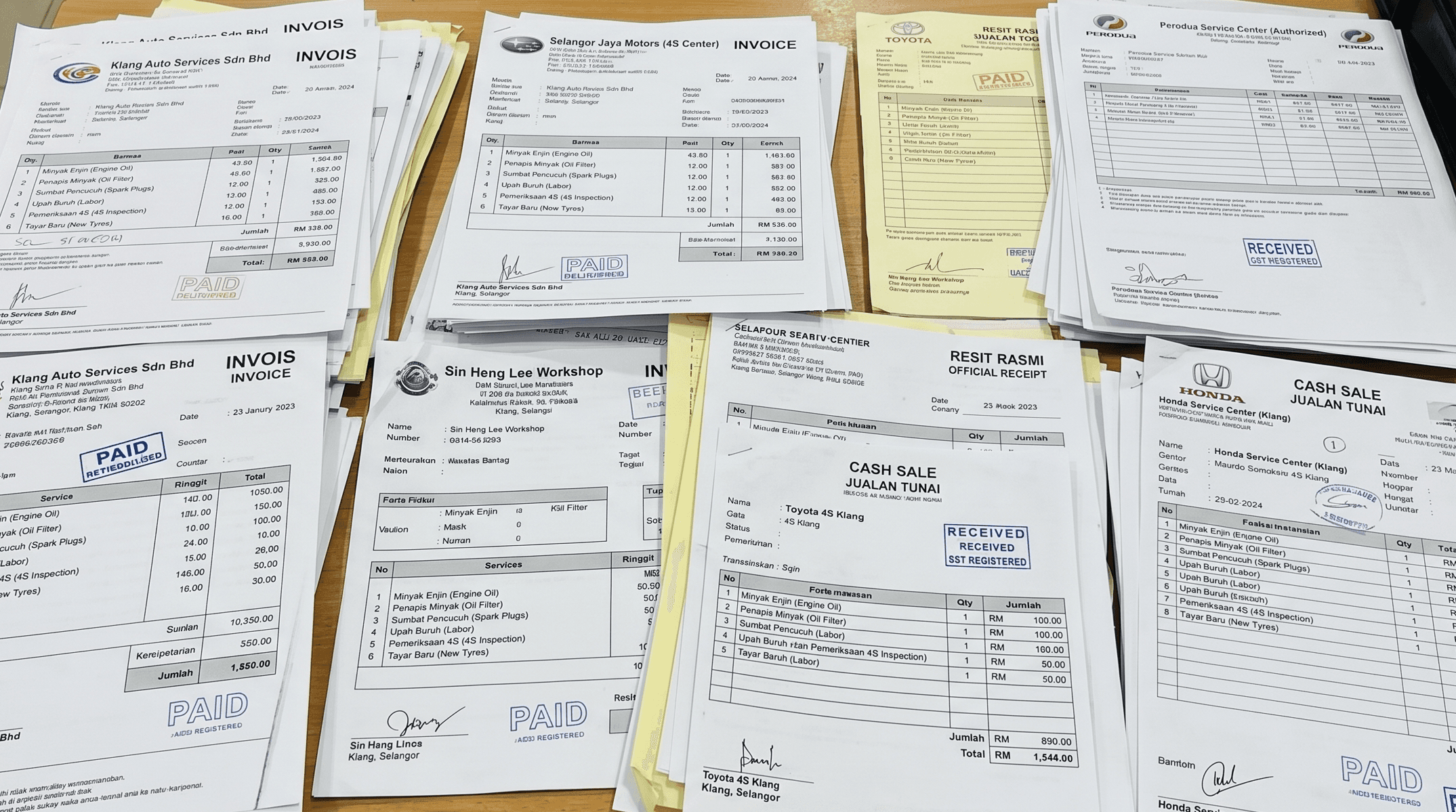
A workshop invoice is one of the most information-dense documents most car owners encounter — and one of the least understood. Most people scan it for the total, sign, and leave. The line items in between go unexamined.
This is not laziness. It is rational behaviour in the face of unfamiliar terminology, time pressure, and the discomfort of appearing uninformed in front of a mechanic who clearly knows more about cars than you do.
But the invoice is the record of what was done to your car. Understanding it — even at a basic level — changes every subsequent workshop interaction you will have.
The three sections of a typical Malaysian workshop invoice
Most workshop invoices in Malaysia, whether handwritten or printed, follow a similar structure. Knowing which section you are reading changes how you evaluate it.
Labour charges | What the workshop charged for the time and skill of the mechanic. Usually listed as a flat rate per job (e.g., "Timing belt replacement — RM150") rather than hourly. Labour is where workshop rates differ most significantly. A higher labour charge at a reputable workshop is often better value than a lower one at a faster, less careful operation. |
|---|---|
Parts charges | The cost of components replaced during the service. This is where you need the most clarity. Each part should be listed individually with its price. If you see a single line that says "parts" with a combined price, ask for the breakdown before you pay. |
Sundries / consumables | Engine oil, coolant, brake fluid, cleaning materials — items that are used during the service but not individually replaced as components. Usually listed separately or included in a service package price. Check that the oil grade listed matches what you requested or approved. |
Common line items and what they mean
Line Item | What it means and what to check |
|---|---|
Engine oil (e.g. 5W-30 SN) | The oil grade. Check this matches what you approved. If the grade listed differs from your usual oil, ask why. |
Oil filter | Replaced with every oil change. Should be on every basic service invoice. If it's not listed, ask whether it was replaced. |
Air filter | Replaced based on condition or interval. If listed, ask to see the old one if you didn't approve this during the service. |
Brake pad (F/R) | F = front, R = rear. Should specify which axle was done. If both are listed, confirm you approved both. |
Labour — brake pad replacement | The mechanic's time charge for the brake job, separate from the parts cost. |
Wheel alignment / balancing | Separate charges. Alignment corrects the angle of the wheels; balancing corrects vibration in the wheel and tyre assembly. Both are legitimate but should be explained before the job, not listed after. |
Coolant flush | Full replacement of coolant. If listed, check the interval — this should not appear at every service. |
Miscellaneous / sundries | Often a catch-all charge for consumables. Ask for a breakdown if it is above RM20–30. |
The questions you are always entitled to ask
Before you sign or pay, you can ask any of the following without it being unusual or confrontational:
"Can you walk me through the parts listed here?"
"This item wasn't mentioned when I dropped the car — when was this approved?"
"What brand of [part] was fitted? Can I see the packaging?"
"Is this listed as a separate charge from the last time I was in, or is it included in the service package?"
"What does [unfamiliar term] mean and why was it done today?"
A workshop that handles these questions smoothly — that answers specifically and without defensiveness — is a workshop that is confident in its own work. The questions themselves are a reasonable quality check.
The item that appears without prior discussion
The most important line item to question is the one you did not approve before the work was done.
In Malaysia, workshops occasionally add items to an invoice that were not part of the original scope discussed at drop-off. Sometimes this is legitimate — the mechanic found something during the service that genuinely needed attention. Sometimes it is not.
The distinction is whether you were consulted before the work was done, not after. Any part replacement or additional service above the originally agreed scope should be communicated to you while the car is still on the lift, not presented as a line item when you come to collect.
If you see an item on your invoice that was not discussed: ask when it was done and whether you were contacted for approval before the work proceeded. If you were not, you are entitled to question whether you owe for it. Most workshops will adjust. The ones that push back have told you something useful about how they operate.
Keep your invoices
Every workshop invoice is a record of your car's service history. Over time, they tell a story: what was replaced and when, which workshop did which work, what the car was at in mileage at each service.
This record has practical value. When a mechanic recommends replacing a part that appears in your invoices from eighteen months ago, you have a starting point for the conversation. When you sell the car, a complete service history is a demonstrable asset. When something goes wrong, the record tells you where to start looking.
Keep them in a folder, photograph them on your phone, or record the key items in a note. The format does not matter. The record does.
The invoice is not the end of the service. It is the record of it. Understand what you are signing before you sign it. Ask about anything you don't recognise. A workshop that cannot explain its own invoice is a workshop that should not be surprised when you don't return.