When you need to replace a part on your car, you will encounter three categories: OEM, OES, and aftermarket. Most car owners either don't know the difference or have a vague sense that OEM is best and everything else is a compromise.
Neither of those positions is quite right. Understanding what each category actually means — and when each one makes sense — is more useful than a ranking.
OEM — Original Equipment Manufacturer
OEM parts are produced by the same manufacturer that supplied the part when your car was built. If your Honda came with Denso spark plugs from the factory, an OEM replacement is a Denso spark plug supplied through Honda's official parts channel.
The key word is channel. The physical part may be identical to what you can buy elsewhere, but OEM parts come packaged in the manufacturer's box, carry the manufacturer's part number, and are sold through authorised dealers at the manufacturer's price. That price includes the brand margin, the distribution chain, and the assurance that what is in the box matches the specification exactly.
OEM is the right choice when the part is complex, safety-critical, or where precise fitment matters absolutely — engine management components, ABS sensors, certain suspension parts. It is also the practical choice if your car is under warranty and you want to avoid any question about parts specification.
OES — Original Equipment Supplier
OES is where the distinction gets interesting, and where most car owners are missing a useful piece of information.
Car manufacturers do not make every part in the car themselves. They source components from specialist suppliers — Bosch, Denso, Gates, Brembo, NGK, Valeo, and many others — who manufacture to the exact specification the carmaker requires. When your car was built, the brake pads may have come from Brembo. The filters from Mann. The belts from Gates or Contitech.
OES parts are produced by these same original suppliers, sold under their own brand rather than the carmaker's. The physical product is the same. The specification is the same. The packaging is different. The price is usually 15–30% lower than OEM.
For most maintenance and repair work, OES is the intelligent choice. You are getting the same part, made by the same company that supplied your car's manufacturer, without the brand margin on top. A Gates timing belt on a Honda is not a compromise. It is the same belt in a different box.
Aftermarket — a wide category, not a single standard
Aftermarket covers every part that is not OEM or OES. This is a large category with enormous variation in quality.
At one end are reputable aftermarket manufacturers — companies like Ferodo, Brembo (aftermarket line), Monroe, KYB — who produce parts to competitive or superior specifications, often with strong engineering backing and independent testing. These are legitimate alternatives, sometimes preferred by performance-oriented mechanics.
At the other end are parts of unknown origin, produced to price points rather than specifications, sold under unfamiliar brand names with no quality documentation. These exist in the Malaysian market and they are the parts that give the aftermarket category its worst reputation.
The category label alone tells you nothing. The brand, the seller's history, and the willingness to provide documentation tell you more.
How to decide which one you need
OEM | When the part is complex or safety-critical. When your car is under manufacturer warranty. When you want zero ambiguity about specification. Expect the highest price. |
OES | For most standard maintenance and repair work. The practical default for brake pads, filters, belts, spark plugs, and fluid system components on a car no longer under warranty. Match the brand to the manufacturer that originally supplied your car model. |
Reputable aftermarket | When a well-known aftermarket brand offers demonstrable quality at a lower price point. Worth considering for suspension components, exhaust parts, and items where the aftermarket segment has strong engineering competitors. Ask your mechanic which brands they trust and why. |
Unknown aftermarket | Avoid for any safety-critical component. The savings are not worth the uncertainty for brakes, steering, or suspension. For purely cosmetic or low-risk items, the risk profile is lower, but caveat emptor applies. |
The question to ask your parts seller
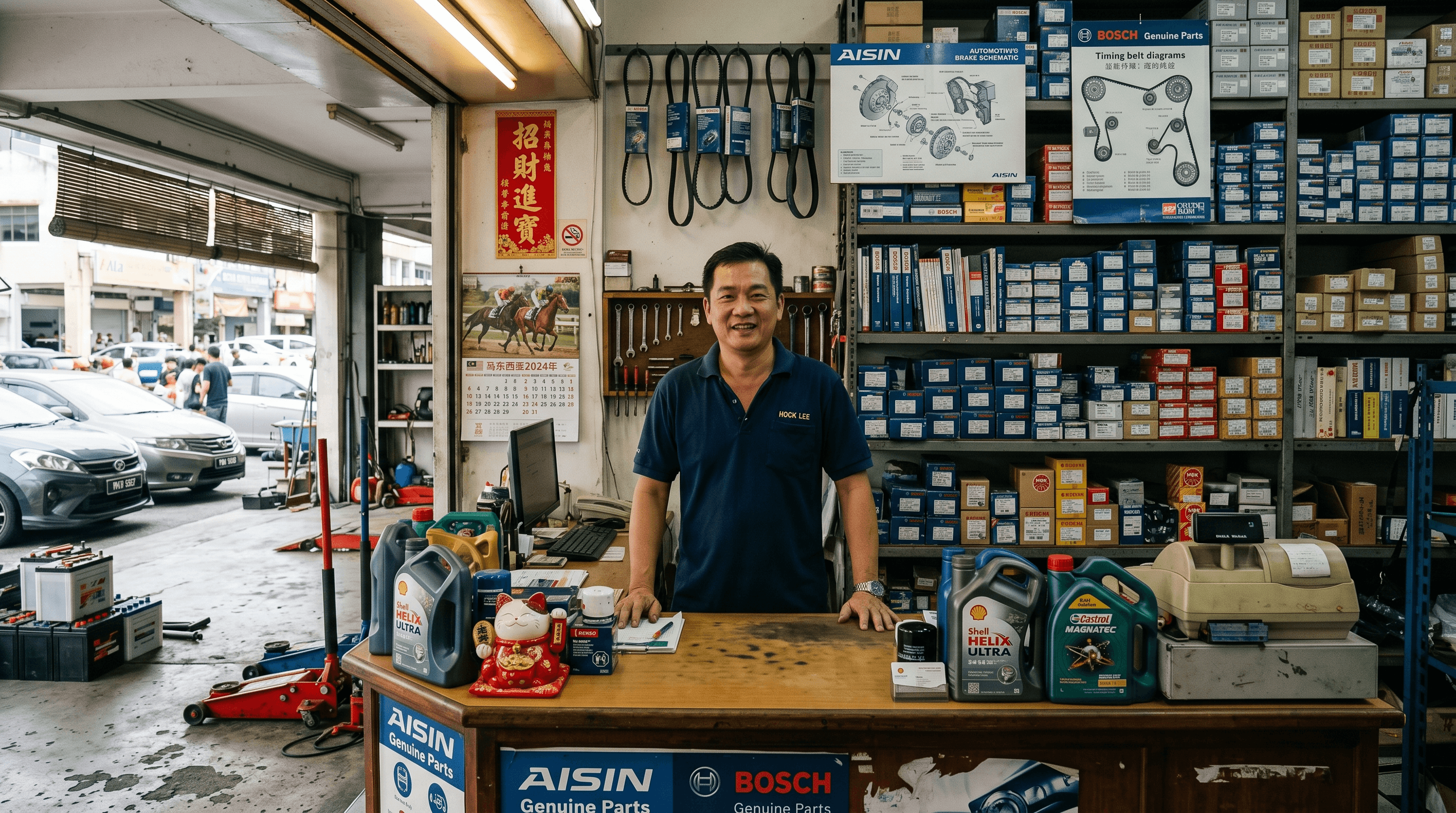
Before you confirm any parts purchase, ask: what brand is this, and who makes it? A seller who can answer specifically — Brembo, Gates, Denso, NGK — is a seller who knows what they are stocking. A seller who answers with a price and a country of origin but no brand name is a seller who cannot tell you what is actually in the box.
The brand is not everything. But the willingness to name it is a basic signal about what kind of seller you are dealing with.
OEM, OES, and reputable aftermarket are not a quality hierarchy from best to worst. They are different channels for parts that may be identical or comparable. The question is not which category — it is which brand, from which supplier, with what assurance.