
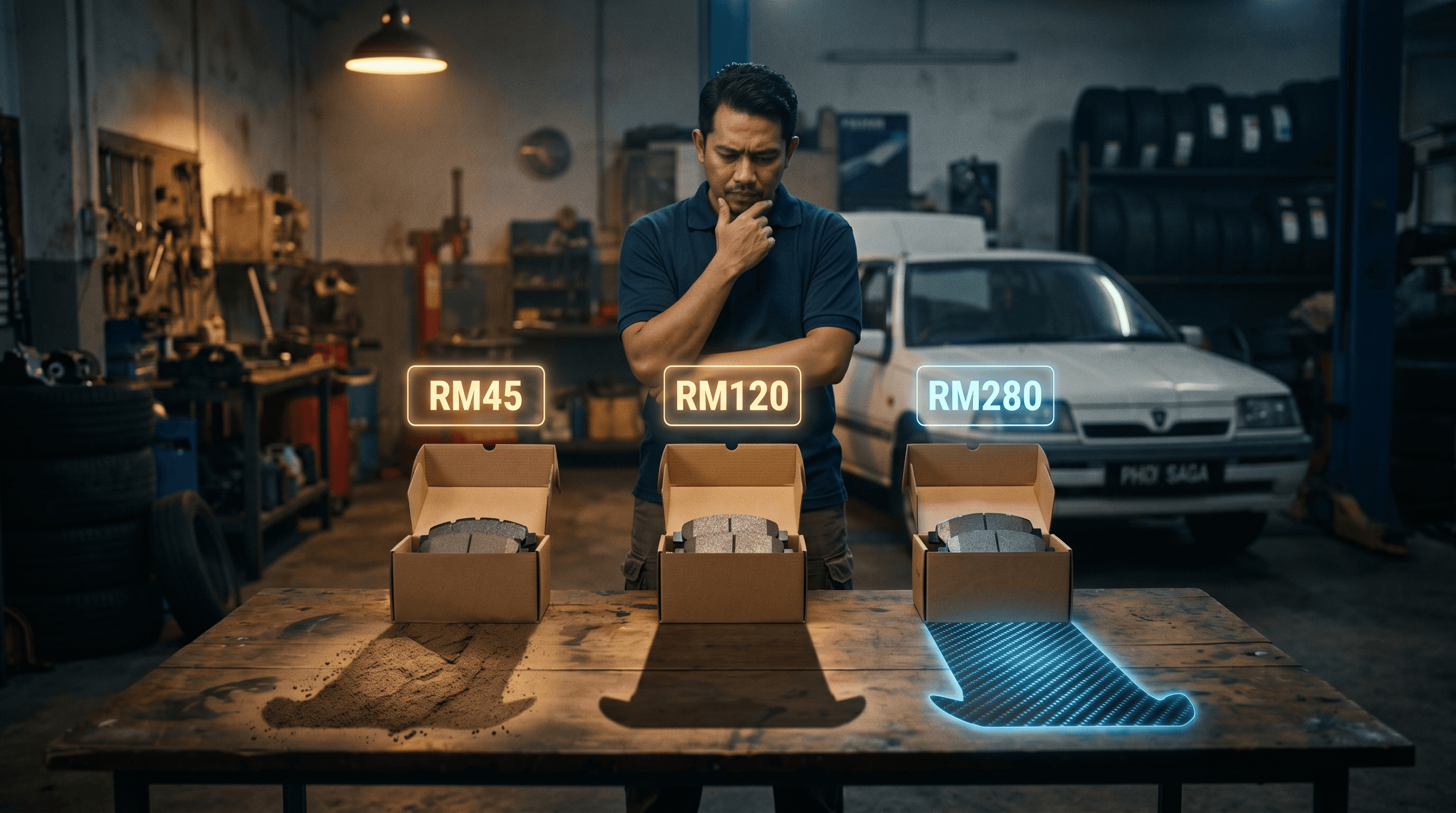
You search for a brake pad set for your Proton Saga. Three listings appear. RM45. RM120. RM280. All claim to fit your car. All are described as brake pads. You have no obvious way to tell whether the difference is the seller's margin, the part's quality, or a combination of both.
This is one of the most common frustrations in buying car parts in Malaysia, and it is not an accident. The price gap is telling you something specific about each product. Understanding what it is saying is worth more than any single purchase decision.
What is actually inside the price
A car part's price is built from several layers, and identifying which layers are present in a given product explains most of the variance you see.
Brand premium | Parts from established manufacturers carry a price that includes the cost of engineering, testing, quality control, and brand reputation. Brembo, Bosch, Ferodo, and their equivalents cost what they cost because there is a documented standard behind the part. You are paying partly for the physical object and partly for the assurance that the object meets a specification. |
Distribution margin | A part that arrives through an authorised distributor, a reputable parts retailer, and then a workshop has passed through multiple hands, each adding a margin. A part sourced more directly — from a verified seller on a platform, for example — may carry fewer layers. The part can be identical; the channel determines part of the price. |
OEM packaging | As discussed in the OEM/OES article: the exact same physical part in the carmaker's box costs more than the same part in the original supplier's box. You are paying for the carmaker's branding and supply chain guarantee, not a different object. |
Production standard | This is where the gap becomes genuinely meaningful for safety-critical parts. A brake pad produced to ECE R90 certification (a European standard for brake performance) has been tested and documented. A brake pad produced to no declared standard, by an unfamiliar manufacturer, at a price that cannot support the cost of testing — that gap in the price reflects a gap in the assurance, not just a better deal. |
The price that should concern you
The very low price is not automatically the dangerous one — it depends entirely on what is behind it. A verified OES part sold by a seller with a track record, at a competitive price, is a good deal. A part with no brand name, no quality certification, and no seller history, at a price that cannot support the cost of real engineering — that is a different situation.
For non-safety-critical parts — cabin filters, cosmetic components, wiper blades — the risk of an unknown-brand part is low. For brake pads, brake discs, tyres, and steering components, the production standard is not a detail. It is the thing you are actually buying.
The price that should also concern you
Very high prices in the aftermarket are not automatically justified. A seller charging RM280 for a brake pad set that retails for RM150 at the authorised distributor is either selling OEM-boxed parts (which may genuinely cost more) or operating at a margin that is not explained by the product. Ask what brand is being sold and cross-reference it before paying significantly above market.
A practical framework for evaluating a price
If you see this | Ask this |
|---|---|
A very low price from an unfamiliar brand | What is the brand name? What production standard or certification does it carry? Can the seller provide documentation? |
A moderate price from a known brand | Is this OES from the original supplier or a reputable aftermarket manufacturer? Usually the right place to be for most parts. |
A high price with OEM labelling | Is this car still under warranty? If not, is there an OES equivalent from the same original supplier at a lower price? |
Three prices for 'the same part' | They are almost certainly not the same part. The brand and production standard differ. Identify each specifically before comparing. |
What a good seller can tell you
A parts seller who understands their stock can tell you, for any given product: the brand name, who manufactures it, what standard it is produced to, and how it compares to the OEM or OES equivalent for your specific car model.
This is not specialist knowledge. It is basic product knowledge that any seller stocking parts should have. A seller who cannot answer these questions is a seller who cannot help you make an informed decision — regardless of their price.
The price gap in auto parts is not random. Brand, distribution channel, production standard, and OEM packaging each add cost for specific reasons. Understanding which reasons apply to a given product tells you whether the gap represents value, assurance, or margin — and gives you the information to decide which one you are willing to pay for.